Author: Hyundai Heat Pump
Published on: 01 June 2026

The key difference between a heat pump and AC is this: an AC only cools your space, while a heat pump both cools and heats — making it a year-round solution for many Indian homes.
Most people buy an AC without ever asking if something better exists. If you live in a city that gets cold winters or you heat water daily, you may be leaving serious savings on the table.
This guide breaks down how a heat pump compares to a standard AC across six key factors — so you can make the right call for your home and climate.
A heat pump and an AC work on the same basic refrigeration cycle. Both move heat from one place to another using a refrigerant. The core difference is direction control.
An AC can only push heat out of your room. A heat pump has a reversing valve that lets it pull heat in during winter or push it out during summer. One device does both jobs.
Most standard split ACs in India — even inverter models — are cooling-only systems. Heat pumps, including air-to-water heat pumps and domestic hot water heat pump systems, are designed for year-round efficiency.
A heat pump absorbs heat energy from outdoor air — even at low temperatures — and transfers it where you need it. In summer, it works like an AC. In winter, it reverses and warms your space or water.
Heat pumps are not just for cold climates. In India, they make the most sense for water heating — and increasingly for space conditioning in hill stations, metros with mild winters, and large homes with high energy bills.
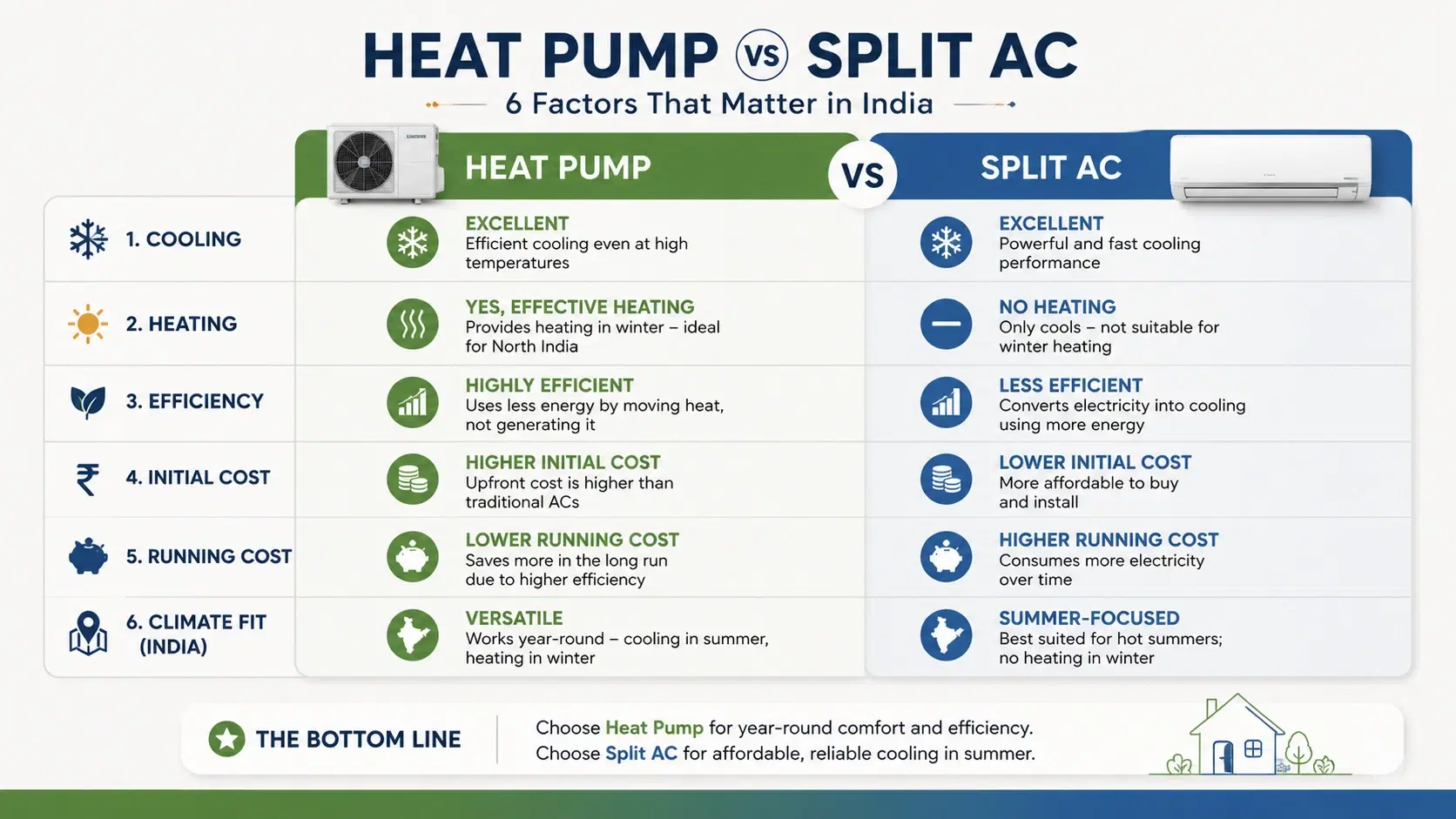
Here's how the two stack up across the six dimensions that matter most for Indian buyers.
| Feature | Heat Pump | Standard Split AC |
|---|---|---|
| Cooling | Yes — same as inverter AC | Yes — primary function |
| Heating | Yes — space + water | No (cooling only) |
| Efficiency (COP) | 3–4x (very high) | 2.5–3.5x (moderate) |
| Initial Cost | ₹40,000–₹1,50,000+ | ₹30,000–₹60,000 |
| Running Cost | 30–50% lower for heating | Higher for heating separately |
| India Climate Fit | Best for hilly/cold zones + water heating nationally | Best for hot, dry, or humid zones |
Key takeaway: A heat pump costs more upfront but pays back faster if you currently spend heavily on geysers or room heaters.
A heat pump makes more financial sense in specific use cases. It's not the right choice for everyone — but for the right household, it's a significant upgrade.
You live in a cold or moderate climate: Cities like Shimla, Mussoorie, Ooty, Pune, Bengaluru, and Dehradun have winters where standard ACs offer no value. A heat pump covers both seasons with one system.
You spend heavily on water heating: The average Indian household spends ₹3,000–₹6,000 per year just running a geyser. A domestic hot water heat pump can cut that bill by up to 60–70%.
You run a hotel, hostel, or commercial property: High daily hot water demand makes the commercial-grade water heat pump (R410A) an obvious choice — faster ROI, lower maintenance costs.
You care about sustainability: Heat pumps produce zero direct emissions. If your electricity comes from renewable sources, your heating footprint drops to near zero.
"I was paying ₹4,500 a month just for heating water at my guest house. After switching to a Hyundai heat pump, that dropped to under ₹1,800. It paid for itself in under two years." — Ramesh K., Guest House Owner, Coorg
Yes — a heat pump can fully replace your AC for cooling, and it adds heating on top. In terms of cooling performance, modern heat pumps match inverter split ACs in speed and energy efficiency.
The only exception: extremely hot and dry climates (like Rajasthan or parts of UP in peak summer) where the ambient temperature regularly crosses 45–48°C. At those extremes, some heat pump models may see reduced efficiency. Always check the rated operating temperature range before buying.
For most Indian cities — including metros like Delhi, Mumbai, Hyderabad, and Chennai — a heat pump handles summer cooling without issue while also giving you winter heating capability your current AC cannot.
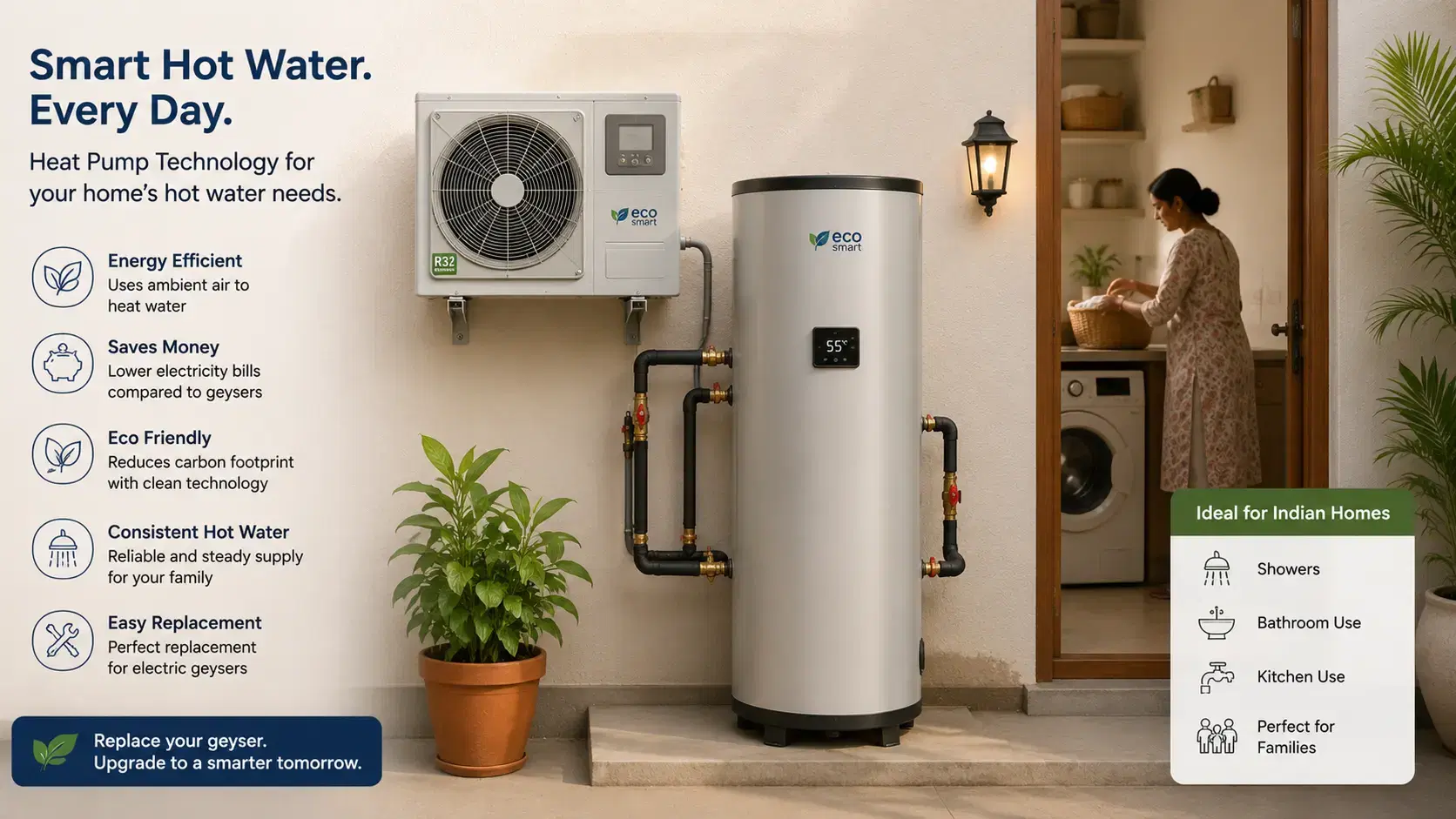
Heat pumps designed for water heating are a direct replacement for electric geysers. They don't cool your room — they heat your water tank using the same refrigeration logic.
For pure summer cooling, a quality split AC and a heat pump are nearly equal. Both use inverter technology, both cool quickly, and both can maintain precise temperatures.
Where the split AC wins in summer: lower upfront cost and wider availability of service technicians across India's tier-2 and tier-3 cities.
Where the heat pump wins even in summer: if you're already planning to buy a geyser or a room heater separately, combining those functions into one device changes the economics fast.
Indian summers present a challenge for all cooling systems — high ambient temperatures reduce efficiency.
"We compared our electricity bill before and after switching to a heat pump for our Bengaluru office. Cooling costs stayed the same, but we saved ₹2,200/month on water heating we used to do separately." — Priya M., Office Manager, Bengaluru
Running cost is where heat pumps build their biggest advantage — but the gap depends on how you currently heat your home or water.
For cooling only: the running cost difference between a 5-star split AC and a heat pump is minimal — both are efficient.
For combined heating and cooling: a heat pump dramatically reduces your total annual energy spend by eliminating a separate heating system.
Use this simple framework:
"The math was simple. I was spending ₹18,000 a year on a geyser plus AC together. The heat pump handles both for ₹9,500. The price difference between systems paid back in 4 years." — Suresh T., Homeowner, Pune
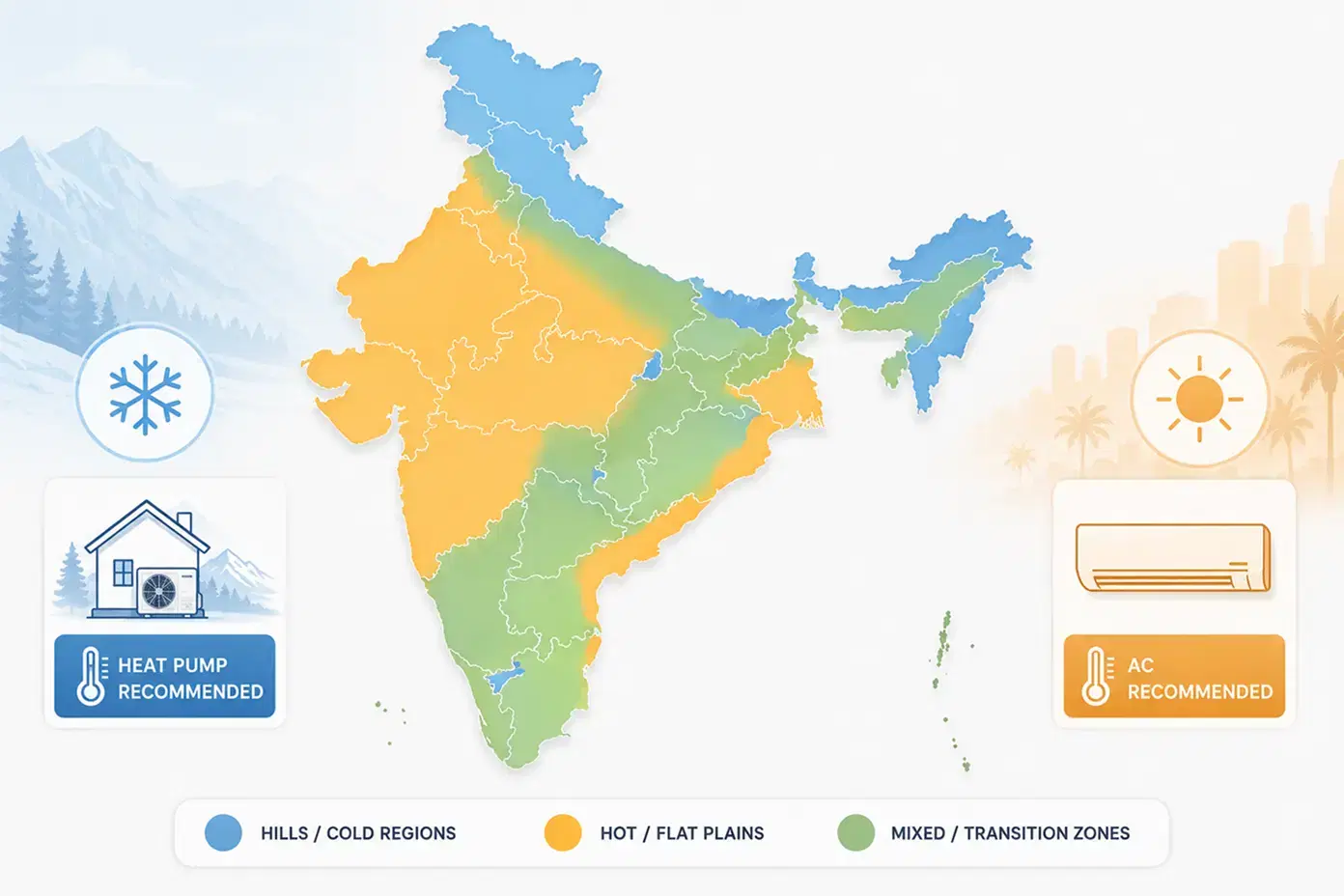
India has one of the most diverse climates in the world. A heat pump isn't universally better — it depends on your geography and usage.
Heat pump clearly wins: Himalayan foothills, Western Ghats, Nilgiris, Deccan Plateau cities with mild winters, any property with heavy daily hot water demand.
Standard AC wins: Rajasthan, Haryana, coastal Tamil Nadu during summer — places where you never need heating and your water heating needs are minimal.
It's close either way: Delhi, Lucknow, Nagpur — cities with both hot summers and cold winters. Here, the right model and usage pattern determines the winner.
The Hyundai heat pump lineup covers both residential and commercial needs, with models suited to India's wide climate range.
Q: Is a heat pump the same as an AC? No. An AC only cools. A heat pump both cools and heats — it uses the same refrigeration technology but can reverse direction. For water heating models, it heats water instead of room air.
Q: Can I use a heat pump in place of my geyser? Yes. Domestic hot water heat pumps are direct geyser replacements. They heat water 2–3x more efficiently than electric geysers and work in most Indian climates year-round.
Q: Does a heat pump work in extreme Indian summers (45°C+)? Most models are rated to operate up to 43–48°C ambient. Check the manufacturer specs. Efficiency drops slightly at very high temperatures, but performance remains functional for most units.
Q: What is the lifespan of a heat pump vs an AC? A well-maintained heat pump lasts 15–20 years. A standard split AC typically lasts 10–15 years. The longer lifespan helps offset the higher upfront cost.
Q: How much does a heat pump cost in India? Prices vary by type and capacity. Water heating heat pumps start around ₹40,000–₹60,000. Space conditioning models with heating capability cost more. Check the heat pump price guide for current options.
Q: Which is better — heat pump or AC for a 2BHK flat in Delhi? If you use a geyser daily and have cold winters, a heat pump system pays off faster. If you only need summer cooling, a 5-star inverter AC is simpler and cheaper upfront.
Heat pumps and ACs are not in direct competition for most buyers — they serve different needs. An AC is a focused cooling tool. A heat pump is an all-in-one energy system that cools, heats, and in many models, replaces your geyser too.
If your energy bills include heating costs — water or space — a heat pump almost always delivers better total value over 5+ years. If you only need summer cooling in a hot, flat geography, a quality inverter AC remains the simpler, cheaper choice.
Ready to see which system fits your home? Explore Hyundai's full heat pump range — including air-to-water, domestic hot water, and commercial models — or read more on the heat pump pillar page to understand the full technology before you buy.
No related articles found.

Dehumidifier vs Air Conditioner: Which Is Right for You?
24 July 2026

What Are Industrial Heat Pumps and How They Work
24 July 2026

Pool Heater: Heat Pump vs Solar vs Gas Compared │ Hyundai
23 July 2026

Heat Pump ROI Calculator in India: Payback Guide
17 July 2026

Air-to-Water vs Air-to-Air Heat Pump Explained │ Hyundai
10 July 2026

Domestic vs Commercial Heat Pump Water Heater
10 July 2026
No related articles found.