Author: Hyundai Heat Pump
Published on: 26 May 2026
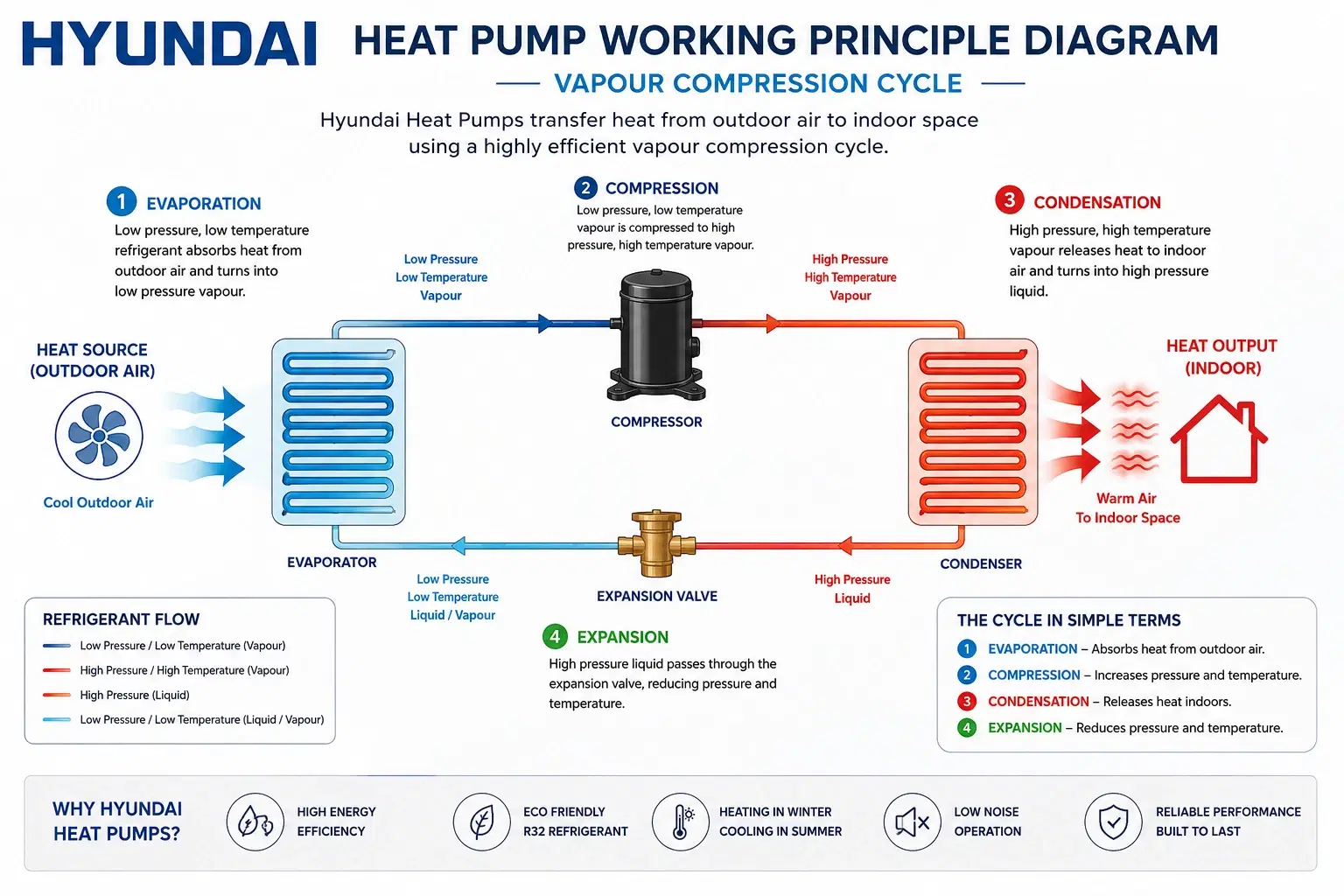
A heat pump works by extracting heat energy from the surrounding air and transferring it to water or indoor spaces — using up to 5× less electricity than a conventional electric geyser. Unlike a heater that generates heat by burning fuel or resistive coils, a heat pump simply moves existing heat, making it the most energy-efficient water heating technology available in India today.
Every Indian household is familiar with the electric geyser — and the steep electricity bills that come with it. Heat pumps solve exactly that problem. In this guide, we break down the working principle of a heat pump in plain language, explain each key component, and show you why millions of Indian homes are making the switch.
A heat pump follows a continuous thermodynamic refrigeration cycle. Here are the 6 core steps:
Understanding the four main components helps you evaluate performance specs when choosing a model:
| Component | Function | What to Look For |
|---|---|---|
| Compressor | Raises refrigerant pressure and temperature | Inverter compressor = variable speed, quieter, more efficient |
| Evaporator Coil | Absorbs heat from ambient air into refrigerant | Larger coil surface area = better performance in mild winters |
| Condenser Coil | Transfers heat from refrigerant to water | Titanium or stainless steel coil resists corrosion in hard-water areas |
| Expansion Valve | Reduces refrigerant pressure to restart the cycle | Electronic expansion valve (EEV) offers finer efficiency control |
| Refrigerant | The fluid that carries heat through the system | R-32 or R-134a — lower global warming potential, legal under Indian norms |
Tip: When comparing Hyundai heat pump models, check if the unit uses an inverter compressor — inverter technology automatically adjusts output based on ambient temperature, delivering 15–20% better efficiency than a fixed-speed compressor, especially on mild Indian winter mornings.
A heat pump runs on electricity and a refrigerant. It does not burn gas, LPG, or solar energy directly. The electricity powers the compressor and fan; the refrigerant is the medium that carries heat. Because it moves heat rather than generating it, a heat pump delivers 3–5 units of thermal energy for every 1 unit of electrical energy consumed — a ratio known as the Coefficient of Performance (COP).
For context: a standard electric geyser has a COP of 1 (1 unit of electricity = 1 unit of heat). A Hyundai heat pump water heater achieves a COP of 3.5–5.0 depending on the ambient temperature — meaning it delivers up to 5× more hot water for the same electricity spend.
Can a heat pump run on solar? Yes — heat pumps are fully compatible with rooftop solar PV systems. Many Indian homeowners pair a Hyundai heat pump with a solar array to bring their effective electricity cost for hot water production close to zero.
If technical diagrams aren't your thing, here's the simplest analogy:
"A heat pump works exactly like your refrigerator — but in reverse. Your fridge pulls heat out of food and dumps it into your kitchen. A heat pump pulls heat out of the outdoor air and dumps it into your water tank."
That is the entire principle. The outdoor air — even on a cool 10°C January morning in Delhi — contains more than enough heat energy to warm a 200-litre tank to 60°C. The heat pump's job is simply to collect that energy efficiently and concentrate it where you need it.
Key takeaway: heat pumps don't create energy — they relocate it. That's why they are so dramatically more efficient than resistive heaters.
| Factor | Heat Pump | Electric Geyser |
|---|---|---|
| Working principle | Moves heat from air to water | Generates heat via resistive coil |
| COP (efficiency ratio) | 3.5 – 5.0 | 1.0 |
| Monthly electricity cost* | ₹300 – ₹500 | ₹1,200 – ₹2,000 |
| CO₂ footprint | Low (uses ambient energy) | High (100% grid electricity) |
| Initial cost | ₹35,000 – ₹1,20,000 | ₹5,000 – ₹18,000 |
| 5-year total cost | Lower | Higher (2–3× running cost) |
| Works in Indian climate? | Yes (–7°C to 43°C) | Yes (any temperature) |
| Installation complexity | Medium (outdoor unit needed) | Low (wall-mount) |
* Estimate based on 200L/day usage at ₹8/unit electricity. Actual savings vary by region and tariff slab.
A heat pump can extract heat from outdoor air down to approximately –7°C, which covers all major Indian metros including Delhi and Shimla during winter months. At lower ambient temperatures, the COP drops slightly — from ~4.5 in summer to ~3.0 in a cold winter — but the unit continues to function and still outperforms an electric geyser in efficiency.
It is called the vapour-compression refrigeration cycle or reversed Rankine cycle. The same thermodynamic principle powers your air conditioner, refrigerator, and industrial chillers — heat pumps simply apply it in reverse to deliver heat rather than cold.
Technically, yes and no. Both use the same refrigeration cycle. However, an AC is optimised to cool indoor air and reject heat outdoors. A heat pump water heater is configured to capture that rejected outdoor heat and use it to warm water. Some multi-function heat pumps can both heat water and cool indoor air simultaneously.
A Hyundai 200-litre heat pump water heater consumes approximately 1.0–1.5 kWh per day to produce 200 litres of 60°C water — compared to 4.0–5.0 kWh for an equivalent electric geyser. Annual savings typically range from ₹12,000 to ₹24,000 depending on your electricity tariff and usage volume.
Yes. Unlike solar water heaters, a heat pump does not require direct sunlight — it draws energy from ambient air temperature. This makes it reliable year-round, including during monsoon and overcast winter days when solar heaters underperform.
Modern Hyundai heat pumps use R-32 or R-134a refrigerants — both of which have significantly lower global warming potential (GWP) than older R-22 refrigerants and comply with India's current HFC regulations under the Kigali Amendment schedule.
No related articles found.

Dehumidifier vs Air Conditioner: Which Is Right for You?
24 July 2026

What Are Industrial Heat Pumps and How They Work
24 July 2026

Pool Heater: Heat Pump vs Solar vs Gas Compared │ Hyundai
23 July 2026

Heat Pump ROI Calculator in India: Payback Guide
17 July 2026

Air-to-Water vs Air-to-Air Heat Pump Explained │ Hyundai
10 July 2026

Domestic vs Commercial Heat Pump Water Heater
10 July 2026
No related articles found.