Author: Hyundai Heat Pump
Published on: 28 October 2026
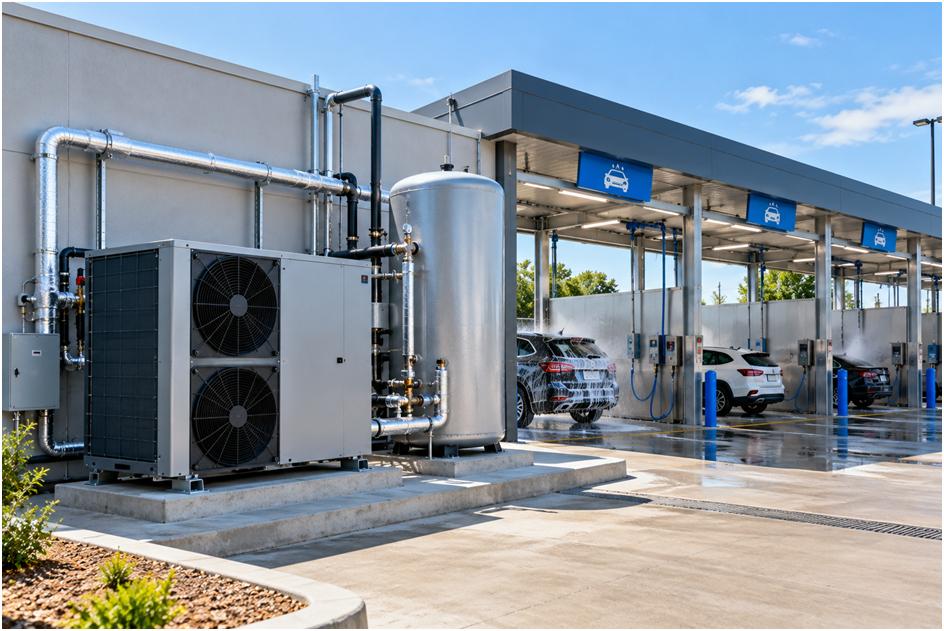
A heat pump for car wash businesses supplies hot water by moving heat from outdoor air instead of burning fuel. It suits sites with steady demand, and it works best when sized to your wash menu, target temperature and busiest hour.
Hot water is one of the few car wash costs you can measure before you spend. Size the system wrong and bays slow down or energy bills climb. Getting commercial water heating for car washes right takes planning up front.
This guide shows where hot water is used, how to estimate demand, which temperatures to plan for and how to compare your options.
Hot water is optional at many washes, so start by listing where your site actually uses it. Common points include heated pre-soak lines, rinse stations, detailing bays, interior cleaning and staff washrooms. Warm water helps loosen oily road film, but the right temperature comes from your chemical supplier's data sheet and your equipment maker, not a rule of thumb.
That list becomes the base for every sizing decision that follows.
Multiply each station's hot water flow by the temperature rise you need, then allow for the stations that run together in your busiest hour. A handy rule: kilowatts ≈ litres per minute × temperature rise in °C × 0.07. A 2025 study in E3S Web of Conferences, using data from a European car wash manufacturer, assumed 5 to 8 litres per minute per station at 55°C. Treat it as a reference, not an Indian benchmark.
In that study, a 200-litre tank gave at least 4.4 minutes of supply with nine stations at 5 L/min. Your site will differ, so confirm with a proper load calculation.
There is no single standard for car wash hot water requirements. The numbers come from your chemical supplier, your equipment maker and your wash menu. The European study above assumed 55°C. Hyundai's commercial RS Series delivers hot water up to 60°C, so confirm every station's target first. If a machine needs hotter water, ask its maker whether preheated feed water is acceptable.
The Victorian Department of Health in Australia notes that a car wash facility has been linked to cases of Legionnaires' disease. It advises against storing water between 20°C and 60°C. Follow local guidance and qualified advice for your site.
It depends on your operating hours and energy costs. A heat pump typically delivers three to four units of heat for each unit of electricity (COP 3 to 4), while an electric element delivers one. That ratio shifts with outdoor and water temperature. The European study found payback shortened as cars per hour rose, so utilisation matters as much as technology.
| Feature | Heat Pump (RS Series) | Electric Geyser | Fuel Boiler |
|---|---|---|---|
| How heat is made | Moves heat from air using electricity | Converts electricity directly to heat | Burns fuel |
| Heat per unit of electricity | COP 3–4 typical | 1 unit | Not applicable |
| Gas line or flue needed | No | No | Yes |
| Best for | Long hours, steady demand | Small, low-use points | Sites with existing fuel supply and very high temperature needs |
Our heat pump ROI calculator guide explains the inputs, and the cost saving page explains the efficiency basics.
Hyundai's commercial RS Series heat pump covers 18 to 192 kW by cascading up to 16 units under one central control. It heats water up to 60°C, operates from -15°C to 43°C ambient and includes MODBUS RS-485 for building management systems. Whether it suits your car wash depends on target temperature, demand profile, electrical supply and outdoor space, so check each against the product specification.
Hyundai advises buffer tanks to cover peak demand, so ask which storage setup fits your busiest hour. Its glass-lined storage tanks come in 100 to 300 litres. For the basics, read domestic vs commercial heat pump water heaters.
Q: Does a car wash need hot water? Not always. It depends on your wash menu and equipment. Many sites heat water only at selected stations, so map your points before sizing anything.
Q: Can a heat pump supply hot water for a car wash? Yes, within its output temperature. A European study modelled air-to-water heat pumps for 55°C car wash duty. Hyundai's RS Series reaches up to 60°C.
Q: How big a heat pump does a car wash need? It depends on flow rates, temperature rise, simultaneous stations and storage. Start with the kilowatt rule above, then request a project-specific assessment.
Q: Can it connect to a building management system? The RS Series includes MODBUS RS-485 for this. Confirm the available data points for your project, and see our heat pump BMS integration guide.
Hot water at a car wash is a design decision, not a guess. Map your stations, calculate peak demand, confirm temperatures and safety, then compare running cost on your own tariff. An energy-efficient hot water system for a car wash suits steady demand, but only a site-specific calculation proves it.
Planning commercial water heating for a car wash or service centre? Share your station list and operating hours with a Hyundai heat pump specialist for a project-specific assessment.
No related articles found.
Heat Pumps for Data Centers: Turning Waste Heat into a Useful Energy Source
2 November 2026
Heat Pump for Commercial Laundry: Planning Hot Water Capacity and Demand
28 October 2026

Heat Pump BMS Integration: A Smarter Approach to Commercial Heating Control
16 October 2026

Heat Pump for Food Processing Industry: Where Heat Recovery Can Improve Plant Efficiency
16 October 2026
Heat Pump for Textile Industry: Opportunities for Heat Recovery in Textile Manufacturing
29 September 2026
Heat Pump for Apartments: How to Plan an Efficient Centralized Hot Water System
24 September 2026
No related articles found.