Author: Hyundai Heat Pump
Published on: 24 September 2026
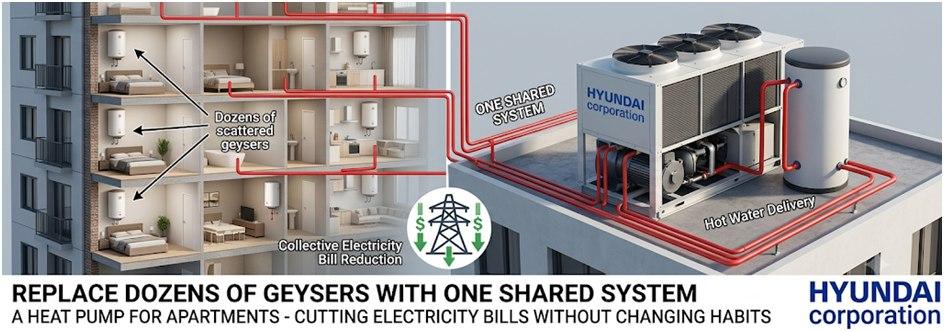
A centralized heat pump for apartments replaces hundreds of individual electric geysers with one shared, efficient plant — cutting connected load, maintenance points, and monthly running costs across the entire building.
Every apartment complex carries a hidden cost: hundreds of small electric geysers, one per flat, each heating water inefficiently and adding to the building's peak electrical load. Developers pay for that wiring capacity upfront, and residents pay for it every month on their bills. A centralized hot water system for apartments takes a different approach — one shared plant, sized for the whole building, delivering hot water to every flat through a common riser.
This guide covers why centralized systems suit multi-family buildings, how to estimate demand correctly, and what developers should check before finalising a system.
Most Indian apartment buildings still rely on individual electric geysers in every flat, multiplying inefficiency across hundreds of units instead of solving it once. Each geyser converts electricity to heat at roughly a one-to-one ratio and adds to the sanctioned electrical load a developer must provision. As buildings grow taller, that per-flat approach strains transformer capacity and common-area wiring. An apartment hot water heating system built around a shared plant avoids this by heating water once, efficiently, for the entire block.
A centralized plant does not just relocate the same load — it changes how efficiently that load is met.
This kind of system works by running several outdoor units in a cascaded, lead-lag configuration connected to shared insulated storage tanks, rather than one large machine doing everything alone. Cold water is pre-heated by the cascade bank, held in buffer tanks, and distributed through an insulated ring main to every flat on demand. Because it moves existing heat from ambient air rather than generating it from scratch, it typically delivers three to four units of heat per unit of electricity used. Hyundai's commercial heat pump range is built for exactly this kind of cascade-connected load.
The cascade design lets one plant serve fifty flats or five hundred — capacity scales by adding units, not redesigning the system.
Sizing starts with occupancy, not flat count. The National Building Code uses standard population assumptions per dwelling type — typically four people for a one-bedroom unit, rising to seven for a four-bedroom-and-above unit — and IS 7558's guidance on domestic hot water works from roughly 45–90 litres per bath or shower event at a 55°C delivery temperature. Multiplying realistic occupancy by peak-hour usage gives a far more accurate demand for a heat pump water heater for apartments than guessing from unit count alone.
Both approaches use the same technology but solve different problems. A centralized plant shares one cascade system and one maintenance contract across the building, usually lowering total equipment count and per-flat cost. Individual units — such as Hyundai's domestic heat pump range — give each flat independent control and billing, which some developers prefer for smaller, low-rise projects. The right choice depends on building size, ownership structure, and how billing will be handled.
| Feature | Centralized Heat Pump | Individual Heat Pump per Flat | Individual Electric Geysers |
|---|---|---|---|
| Equipment count | Low — one cascade bank | Medium — one unit per flat | High — one geyser per flat |
| Typical efficiency (COP) | 3–4 | 3–4 | Close to 1 |
| Maintenance points | Single plant room | Distributed across flats | Distributed across flats |
| Best for | Mid- and high-rise towers | Low-rise projects, villas | Not recommended at scale |
A centralized system wins on efficiency and maintenance simplicity at scale; individual units win on billing independence for smaller projects.
Capacity planning depends on more than resident count. Ambient temperature range matters — a system built for mild climates underperforms during a Delhi summer or a north Indian winter, so commercial units rated for -15°C to 43°C, like Hyundai's RS Series, hold output through both extremes. Plant room or rooftop space, airflow clearance, water pressure from the overhead tank, and three-phase power availability shape the final design just as much as the demand calculation itself.
Choosing a system is a due-diligence exercise as much as a technical one. Developers should confirm the manufacturer's track record with multi-unit residential and commercial installations, since cascade control logic and reliability differ at building scale. RWAs inheriting a completed project should ask for documented service coverage and remote monitoring, since a plant serving hundreds of flats carries a far higher cost of downtime than a single household unit.
A few weeks of due diligence at the selection stage is far cheaper than correcting an undersized plant after handover.
Q: Can one centralized system realistically serve a large apartment tower? Yes. Capacity scales by adding units to the cascade bank rather than replacing the system, so towers with hundreds of flats are served the same way as smaller blocks.
Q: Is a centralized system more efficient than individual geysers per flat? Generally, yes — a shared heat pump plant typically delivers three to four units of heat per unit of electricity, against roughly one-to-one for a resistance geyser.
Q: How is the cost of a centralized system usually billed to residents? That depends on the RWA's model. Some buildings fold running costs into common-area maintenance; others sub-meter each flat's draw — both are billing decisions, not equipment limitations.
Q: Does a centralized heat pump system need a gas connection? No. It runs entirely on electricity, drawing heat from ambient air through a refrigeration cycle, with no gas line or combustion in the plant room.
Q: Can an existing apartment complex retrofit a centralized system? Often, yes, provided there is adequate plant room space and the riser network can be adapted. A phased installation plan is usually recommended to limit disruption.
Q: What happens to hot water supply if one cascade unit needs servicing? The remaining units keep supplying the building while that unit is serviced — one of the main reliability advantages of a multi-unit centralized design.
Planning a heat pump for apartments comes down to three decisions: an accurate demand estimate based on real occupancy, a cascade-connected system sized for Indian ambient extremes, and confirmed plant room and power infrastructure before installation begins. Get those right, and every flat gets consistent hot water while the building spends far less collectively than hundreds of individual geysers ever could.
Planning a centralized hot water system for your project? Talk to a Hyundai heat pump specialist for a capacity assessment matched to your building's flat count and occupancy.
No related articles found.

Heat Pump BMS Integration: A Smarter Approach to Commercial Heating Control
16 October 2026
Heat Pump for Food Processing Industry: Where Heat Recovery Can Improve Plant Efficiency
16 October 2026
Heat Pump for Textile Industry: Opportunities for Heat Recovery in Textile Manufacturing
29 September 2026
Heat Pump vs Solar Water Heater: Which Is Right for You?
24 September 2026
Heat Pump for Hospitals: A Guide to Reliable and Energy-Efficient Hot Water Systems
11 September 2026
Heat Pump for Hotels: How to Reduce Hot Water Energy Costs Without Compromising Guest Comfort
10 September 2026
No related articles found.