Author: Hyundai Heat Pump
Published on: 16 October 2026
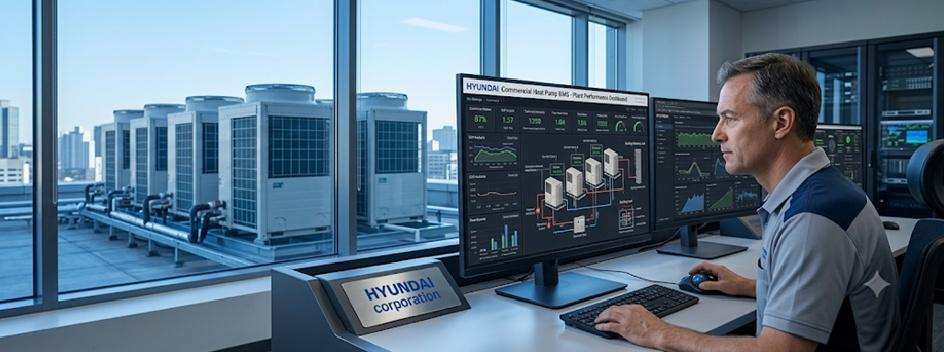
Heat pump BMS integration links a commercial heat pump plant to the building management system, so facility teams can schedule, monitor and coordinate hot water production from one screen instead of checking the plant room in person.
Many commercial heat pump plants run as separate islands, so nobody sees a fault until someone complains about cold water. Connecting the plant to the building management system (BMS) lets the facility team watch, schedule and review heating like any other system.
This guide explains how the connection works, how scheduling can follow demand, and what to check before you commit.
Heat pump BMS integration means linking the heat pump's controller to the building management system through a shared communication protocol. The BMS can then read data such as unit status and water temperatures, and send commands such as start, stop or setpoint changes. Hyundai's commercial RS Series lists MODBUS RS-485 communication as standard for this purpose.
Exact data points vary by model, so request the register list before design begins.
They exchange data over a protocol, and in commercial plant systems that is often Modbus. Modbus RTU runs over a two-wire RS-485 serial line, where one master controller polls each device by its unique address. A standard RS-485 segment allows up to 32 devices without a repeater, as described in the Modbus Organization's specifications. Systems built on BACnet usually connect through a protocol gateway.
Cable length limits fall as speed rises, so confirm the baud rate and run length with your controls contractor.
Wiring and addressing errors are a common cause of commissioning delays.
MODBUS carries data between the plant and the BMS, while the heat pump's own central control decides how units work together. On the RS Series, up to 16 units, from 18 kW to 192 kW, can be cascaded under one central control that uses lead-lag logic to bring units on and off with demand. The BMS then manages that plant as one system, which is what makes commercial heat pump controls useful at building scale.
The plant controller protects each compressor and balances run time. The BMS handles schedules, alarms and reports.
Clear ownership keeps the system predictable.
| Feature | Standalone Controls | BMS-Integrated Plant |
|---|---|---|
| Visibility | Local display only | Central dashboard |
| Scheduling | Set unit by unit | Set from one platform |
| Alarms | Noticed on site visits | Sent to the control room |
| Energy data | Manual readings | Logged for trend review |
| Best for | A single small plant | Multi-unit or multi-system sites |
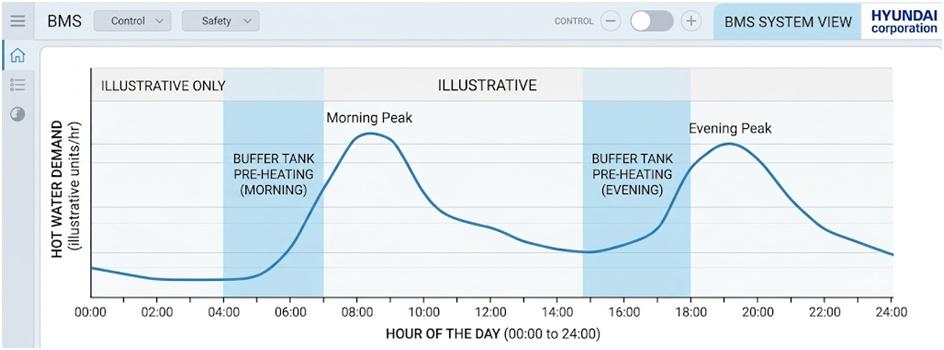
Schedules can follow occupancy and electricity tariffs by starting heat pumps before known peaks and easing off in quiet hours. Heat pumps heat water gradually, so they work best with buffer tanks that store hot water ahead of the morning or evening rush. Timing matters for running cost, because many commercial consumers now face time-of-day tariffs.
Under the Electricity (Rights of Consumers) Amendment Rules, 2023, time-of-day tariffs for commercial and industrial consumers above 10 kW maximum demand were due by 1 April 2024, with peak-hour rates at least 1.2 times normal, per a Ministry of Power reply in Parliament. Hours and slabs vary by state.
A schedule built on real usage beats one built on assumptions.
Check four things first: your BMS protocol, the data points the heat pump exposes, the cable distance, and who commissions the link. If the BMS runs on BACnet, ask whether a gateway is needed. Share your building energy management system integration requirements with the supplier before you finalise the order.
Larger projects may also fall under the Energy Conservation and Sustainable Building Code, which covers commercial buildings with a connected load of 100 kW or more, once a state adopts it.
A short integration scope document prevents disputes later.
Focus on daily decisions: live status, fault alarms, schedule control and data logging. Heat pump remote monitoring through a BMS lets one team watch several plants without site visits. Ask whether each feature is available on your specific model, since capabilities differ between product lines. Hyundai's Smart IoT page covers the unit-level intelligence beneath any BMS layer.
Test every point on site before sign-off.
Q: Does the Hyundai RS Series support BMS integration? Yes. Hyundai lists MODBUS RS-485 communication as standard on the commercial RS Series. Confirm the available data points for your project with the sales team.
Q: Can a heat pump connect to a BACnet BMS? Often yes, through a Modbus-to-BACnet gateway. Agree who supplies and configures it.
Q: How many heat pumps can share one MODBUS network? A standard RS-485 segment supports up to 32 devices without a repeater. Your BMS or gateway may set a lower limit.
Q: Does every commercial heat pump need BMS integration? No. A single small plant may run well alone. Integration helps most with several units or a central control room.
Q: What does heat pump remote monitoring include? It usually covers status, temperatures and fault alarms, depending on the unit and BMS setup. Confirm exact points before purchase.
Heat pump BMS integration works best when planned early: confirm the protocol, request the register list and test every monitored point before handover. See how it fits a centralized apartment system, hotel or hospital project.
Planning BMS integration for a commercial hot water plant? Talk to a Hyundai heat pump specialist about MODBUS connectivity and cascade design.
No related articles found.

Heat Pump for Food Processing Industry: Where Heat Recovery Can Improve Plant Efficiency
16 October 2026

Heat Pump for Textile Industry: Opportunities for Heat Recovery in Textile Manufacturing
29 September 2026
Heat Pump for Apartments: How to Plan an Efficient Centralized Hot Water System
24 September 2026

Heat Pump vs Solar Water Heater: Which Is Right for You?
24 September 2026

Heat Pump for Hospitals: A Guide to Reliable and Energy-Efficient Hot Water Systems
11 September 2026
Heat Pump for Hotels: How to Reduce Hot Water Energy Costs Without Compromising Guest Comfort
10 September 2026
No related articles found.