Author: Hyundai Heat Pump
Published on: 19 May 2026
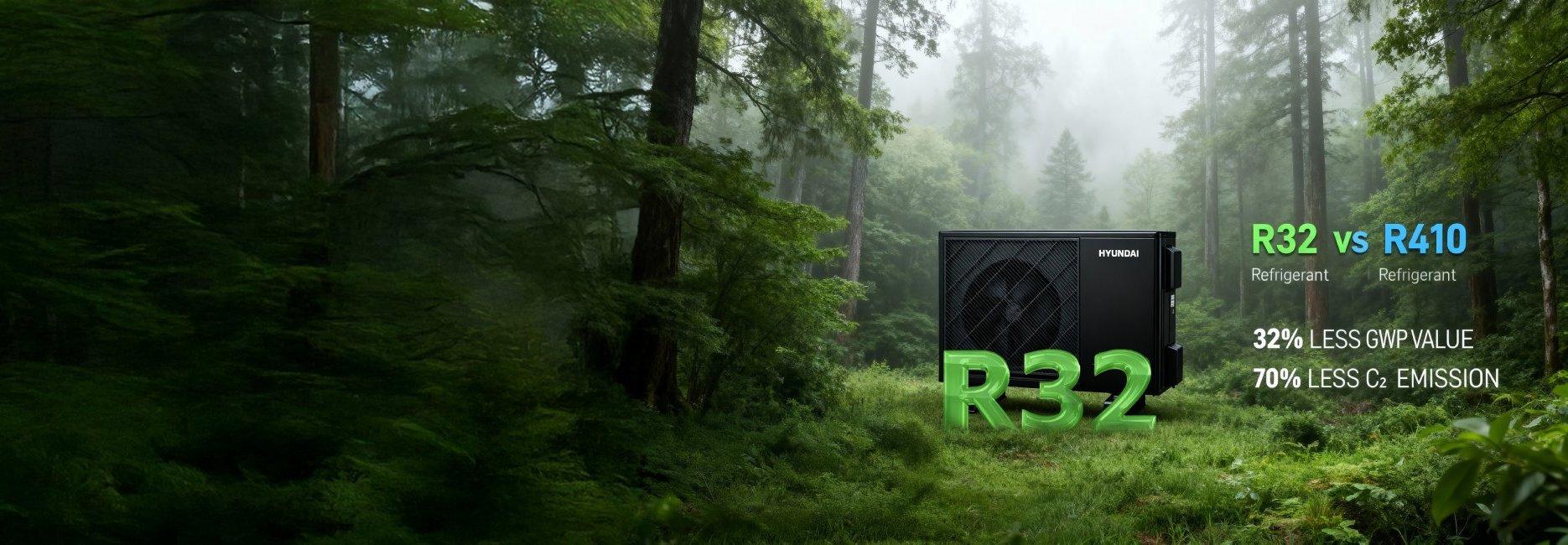
Quick Answer : R32 is the superior refrigerant for modern heat pumps in 2025. It has a Global Warming Potential (GWP) of just 675 - roughly one-third of R410A's GWP of 2,088 while delivering 5–10% better energy efficiency, lower refrigerant charge volumes, and lower long-term operating costs. R410A is being phased out globally and in India under the Kigali Amendment. If you're buying a new heat pump, always choose R32.
A refrigerant is the working fluid inside a heat pump's sealed refrigeration circuit. It cycles continuously through four stages - compression, condensation, expansion, and evaporation absorbing heat from the surrounding air and releasing it into your water tank or living space.
The choice of refrigerant affects virtually everything about a heat pump's performance:
In the heat pump market - whether for water heating, space heating, or air conditioning - the dominant refrigerants of the last decade have been R410A and, increasingly, R32.
Understanding the difference between them is no longer just a technical exercise: with global refrigerant phase-out regulations reshaping the industry, your next heat pump purchase decision is directly affected.
| Property | R32 | R410A |
|---|---|---|
| Chemical Name | Difluoromethane (CH₂F₂) | 50% R32 + 50% R125 |
| GWP (100-year) | 675 | 2,088 |
| ODP (Ozone Depletion) | 0 | 0 |
| Flammability Class | A2L (mildly flammable) | A1 (non-flammable) |
| Refrigerant Charge Volume | ~30% less than R410A | Baseline |
| Energy Efficiency (COP) | 5–10% higher than R410A | Baseline |
| Refrigerant Cost | Lower | Higher |
| Discharge Temperature | Higher (~20°C above R410A) | Lower |
| Operating Pressure | Slightly higher than R410A | High |
| Atmospheric Lifetime | ~5 years | ~9 years |
| Phase-Out Status | Transition refrigerant | Being phased out globally |
| Kigali Amendment Impact | Compliant (medium-term) | Non-compliant (phase-out) |
| Availability (India 2025) | Widely available | Still available, declining |
| Retrofitting | Cannot replace R410A directly | N/A |
| Recycling/Recovery | Easier (single-component) | Complex (blend) |
| Best For | New heat pump systems | Legacy systems only |
R32, chemically known as difluoromethane (CH₂F₂), is a single-component hydrofluorocarbon (HFC) refrigerant developed as a next-generation alternative to older, higher-GWP refrigerants like R410A.
Daikin, the Japanese HVAC giant, was among the first manufacturers to commercialise R32 at scale and critically, made its patents available to the broader industry in 2012 to accelerate adoption. Today, R32 is the dominant refrigerant in new heat pump and air conditioning systems across Japan, Australia, Europe, and increasingly India.
Single-component purity: Unlike R410A, which is a blend of two refrigerants (R32 and R125), pure R32 does not suffer from "fractionation" — the unequal boiling off of different components during a leak. This means R32 systems are easier to recharge and service accurately.
Lower GWP: At 675, R32's Global Warming Potential is approximately one-third of R410A's (2,088). For every kilogram of R32 that leaks into the atmosphere, the warming impact is dramatically lower than an equivalent R410A leak.
Higher energy density: R32 has a higher latent heat of vaporisation per unit mass than R410A. This means you need roughly 30% less refrigerant by weight to achieve the same heat transfer capacity reducing both material cost and environmental risk in the event of leaks.
Mildly flammable (A2L class): R32 is classified as A2L — mildly flammable — by the ASHRAE refrigerant safety classification system. This is distinct from highly flammable refrigerants like propane (R290). In practice, R32 requires a high ignition energy (equivalent to an open flame) and will not ignite from a spark or static electricity under normal conditions. All modern heat pump equipment designed for R32 incorporates engineering controls to manage this.
R410A is a near-azeotropic blend of two HFC refrigerants: 50% R32 and 50% R125 (pentafluoroethane). It was developed in the late 1990s as a replacement for R22 (a chlorofluorocarbon, or CFC, that was depleting the ozone layer). R410A itself has zero Ozone Depletion Potential (ODP), which made it the hero refrigerant of the early 2000s.
However, R410A's high Global Warming Potential of 2,088 meaning 1 kg of R410A has the same warming effect as 2,088 kg of CO₂ over 100 years has made it the target of the next round of global phase-outs under the Kigali Amendment to the Montreal Protocol.
Non-flammable (A1 class): R410A is classified as non-flammable under ASHRAE standards, which made installation and regulatory compliance simpler. This was a key reason for its widespread adoption in residential HVAC throughout the 2000s and 2010s.
Blend complexity: Because R410A is a blend, any refrigerant leak results in fractionation the lighter R32 component vaporises faster than R125, leaving behind a richer R125 mixture. This makes accurate recharging after a leak more complex and potentially wasteful.
Higher refrigerant charge requirements: R410A systems require approximately 30% more refrigerant by weight than equivalent R32 systems for the same capacity. With refrigerant costs rising as production winds down, this becomes a significant servicing cost factor.
Phase-out trajectory: Under the Kigali Amendment, India committed to reducing HFC consumption (including R410A) by 85% from baseline levels by 2047, with the freeze and first reduction steps beginning in 2024–2028. Major manufacturers including Daikin, Mitsubishi, LG, and Hyundai have already shifted their new product lines entirely to R32.
This is arguably the most important question for a heat pump buyer in India where electricity costs are rising and long-term operational economics matter enormously.
The Coefficient of Performance (COP) measures how much heat energy a system delivers for every unit of electrical energy consumed. A COP of 4.0 means 1 kWh of electricity produces 4 kWh of heat.
R32 systems consistently demonstrate 5–10% higher COP than equivalent R410A systems under the same operating conditions. The reasons are thermodynamic:
For a 200-litre heat pump water heater running 365 days/year in a warm Indian climate:
| System | COP | Daily Units (kWh) | Annual Cost (₹8/unit) |
|---|---|---|---|
| R410A heat pump (200L) | 3.6 | 1.55 | ₹4,526 |
| R32 heat pump (200L) | 3.9 | 1.43 | ₹4,175 |
| Annual difference | — | 0.12 units/day | ₹351 saved/year |
While the per-year saving from refrigerant choice alone appears modest, the cumulative impact over 10–12 years is ₹3,500–₹4,200 and this gap widens as electricity tariffs increase. More importantly, the R32 advantage compounds with system design improvements: heat pumps purpose-built for R32 (not retrofitted) are engineered from the ground up for optimal thermodynamic efficiency at R32's specific operating pressures and temperatures.
This matters especially in India. R32 maintains better capacity and efficiency at high ambient temperatures (38–45°C) - the summer conditions prevalent across most of India compared to R410A.
This is due to R32's higher critical temperature (78°C vs 72°C for R410A), meaning the refrigerant can still condense efficiently even when outdoor temperatures are very high.
GWP measures how much infrared radiation a greenhouse gas traps relative to CO₂ over a 100-year period. A GWP of 2,088 (R410A) means every kilogram released has the same warming impact as 2,088 kilograms of CO₂.
| Refrigerant | GWP | Equivalent CO₂ per kg leaked |
|---|---|---|
| R32 | 675 | 675 kg CO₂ |
| R410A | 2,088 | 2,088 kg CO₂ |
| R22 (old CFC) | 1,810 | 1,810 kg CO₂ |
| R290 (propane) | 3 | 3 kg CO₂ |
| R454B (next gen) | 466 | 466 kg CO₂ |
| CO₂ (R744) | 1 | 1 kg CO₂ |
A typical residential heat pump contains 0.8–2.5 kg of refrigerant. A full refrigerant leak from an R410A system releases the equivalent of 1.7–5.2 tonnes of CO₂ into the atmosphere. The same leak from an R32 system releases the equivalent of 0.54–1.7 tonnes of CO₂ — roughly one-third the damage.
India has over 120 million air conditioning and heat pump units in operation. At a national scale, the shift from R410A to R32 represents a meaningful contribution to the country's climate commitments under the Paris Agreement and the Kigali Amendment.
Both R32 and R410A have zero ODP — neither depletes the stratospheric ozone layer. This distinguishes them from the legacy R22 refrigerant, which had an ODP of 0.055 and was the primary driver of ozone layer depletion.
This is the most common consumer concern about R32, and it deserves a clear, honest answer.
R32 is classified A2L by ASHRAE 34:
In practice, R32 will only ignite under very specific conditions:
All reputable heat pump manufacturers (Daikin, Mitsubishi, Hyundai, AO Smith) build in multiple safety layers for R32 systems:
The IEA and ASHRAE both confirm that R32 is safe for residential use when installed and maintained by trained technicians. Millions of R32 systems operate safely across Japan, Australia, China, and Europe.
| Safety Factor | R32 | R410A |
|---|---|---|
| Toxicity | Low (Class A) | Low (Class A) |
| Flammability | Mildly flammable (A2L) | Non-flammable (A1) |
| Risk in sealed system | Minimal | Minimal |
| Risk of accidental ignition | Very low | None |
| Operating pressure | Slightly higher | High |
| Asphyxiation risk | Low (with ventilation) | Low (with ventilation) |
| Regulatory compliance | Compliant (Kigali) | Phase-out underway |
Bottom line on safety: R410A is technically easier to handle from a pure flammability standpoint. But R32's mildly flammable classification poses no meaningful risk in a properly installed, modern heat pump system. The regulatory and environmental risks of R410A are now considered far more serious than the theoretical fire risk of R32.

| Refrigerant | Approximate Cost per kg (India, 2025) | Typical System Charge | Total Refrigerant Cost |
|---|---|---|---|
| R32 | ₹350–₹500/kg | 0.8–1.2 kg (200L unit) | ₹280–₹600 |
| R410A | ₹600–₹900/kg | 1.1–1.8 kg (200L unit) | ₹660–₹1,620 |
R410A is already more expensive per kilogram due to declining production and the cost of R125 (the other component of the blend). As phase-out regulations tighten further through 2025–2028, R410A prices are expected to increase by 30–60%, while R32 pricing remains relatively stable as production scales up.
| Cost Factor | R32 System | R410A System (10-year) |
|---|---|---|
| Refrigerant refill (per service) | ₹500–₹900 | ₹900–₹1,800 |
| Servicing complexity | Simpler (single component) | More complex (blend) |
| Future availability | Assured (transition refrigerant) | Uncertain post-2028 |
| System efficiency savings vs R410A | +₹3,500–4,200 (10-yr) | Baseline |
India ratified the Kigali Amendment to the Montreal Protocol in 2021. Under this commitment, India is classified as an Article 5 country with the following HFC reduction schedule:
| Phase | Timeline | Action |
|---|---|---|
| Baseline establishment | 2024–2028 | HFC production/consumption levels recorded |
| Freeze | 2028 | HFC consumption frozen at baseline |
| First reduction (10%) | 2032 | 10% reduction from baseline |
| Second reduction (20%) | 2037 | 20% reduction from baseline |
| Further reductions | 2042–2047 | Down to 15% of baseline |
This schedule directly affects R410A availability and pricing in India. While R410A is not being banned overnight, manufacturers are already accelerating the shift:
Practical implication for buyers: If you purchase an R410A heat pump in 2025, you risk higher servicing costs, possible refrigerant unavailability, and reduced resale value as the market transitions. Always specify R32 when purchasing a new heat pump system.
Heat pump water heaters operate slightly differently from air-to-air heat pumps (air conditioners). The key differences that affect refrigerant choice:
Water heating requires the refrigerant to reach higher condensing temperatures (55–65°C for hot water delivery) compared to the ~40–45°C needed for air conditioning. This is where R32's higher discharge temperature becomes relevant.
R32 naturally operates at higher discharge temperatures than R410A — which can be an advantage (enabling higher hot water temperatures) or a challenge (requiring compressor and component design to manage heat). Modern heat pump water heaters purpose-built for R32 are engineered to leverage this characteristic, often achieving hot water delivery temperatures of 60–65°C — sufficient for legionella control — without supplementary heating.
| Ambient Temperature | R32 COP | R410A COP | R32 Advantage |
|---|---|---|---|
| 15°C (winter morning) | 2.8 | 2.5 | +12% |
| 25°C (moderate) | 3.8 | 3.5 | +8.6% |
| 35°C (summer) | 4.2 | 3.9 | +7.7% |
| 42°C (peak summer) | 3.9 | 3.4 | +14.7% |
R32's advantage is most pronounced at extreme temperatures — both winter cold and peak Indian summer heat — making it particularly well-suited to the Indian climate.
While R32 is the mainstream transition refrigerant today, the refrigerant roadmap continues to evolve:
For a heat pump purchased today in India, R32 is the right choice — it will remain the dominant residential refrigerant through at least 2035, giving you a full system lifetime of compliance and strong secondary market support.
If your current heat pump water heater or air conditioner runs on R410A, here is your action plan:
Your existing R410A system will continue to function normally. R410A is not being withdrawn from the Indian market immediately — servicing and refilling will remain available through at least 2030 for existing systems.
With R410A pricing rising, even small refrigerant leaks become more costly. Annual professional servicing — including leak testing, joint inspection, and filter cleaning — becomes economically essential.
R32 cannot directly replace R410A in an existing system. The operating pressures, lubricating oils, seals, and component sizing are different. Attempting a refrigerant swap without full system reconditioning can cause compressor failure, seal degradation, and system damage. Only a complete system replacement justifies the switch.
If your R410A heat pump is more than 6–7 years old and requires a major repair (compressor, heat exchanger), the economics of replacement with an R32 system are likely superior to repair. Factor in:
When evaluating a new heat pump water heater or air-to-water heat pump system, follow this decision framework:
For any heat pump purchased in 2025 or later, R32 should be the default. It offers better efficiency, lower environmental impact, and future-proof compliance.
The Bureau of Energy Efficiency's star label reflects real-world efficiency under Indian conditions. Look for BEE 4-Star or 5-Star rated units — these invariably use R32 in 2025 models.
Not all R32 heat pumps are equal. Brands like Hyundai, Daikin, AO Smith, Mitsubishi Electric, and Jaquar have purpose-designed their refrigeration circuits for R32 — not simply swapped refrigerant in an R410A chassis. Ask your dealer for the unit's COP certification test data.
Ensure your local service engineers are trained and certified for R32 handling. Major brands' authorised service centres will be, but smaller third-party service shops may still primarily handle R410A. R32 servicing requires A2L-rated recovery equipment and trained personnel.
If you are investing in a premium, high-capacity system (300L+ water heater or whole-home heat pump), ask whether the manufacturer has a roadmap toward R290 or R454B. This matters if you plan to use the system for 15+ years.
Answer: Yes. R32 is better than R410A in every measurable dimension that matters for a heat pump buyer: it delivers 5–10% higher energy efficiency (COP), requires 30% less refrigerant charge, has one-third the Global Warming Potential (GWP 675 vs 2,088), and is future-proof under global and Indian refrigerant regulations. The only advantage R410A retains is its non-flammable A1 safety classification, but this theoretical advantage does not translate to meaningful real-world risk in properly installed R32 systems.
Answer: No — R32 cannot be used as a direct drop-in replacement for R410A. The two refrigerants operate at different pressures, require different lubricating oils, and demand different component tolerances. Attempting to mix or substitute them risks compressor failure, refrigerant leaks, and system damage. The only way to switch is a full system replacement.
Answer: Yes, with proper installation. R32 is classified A2L — mildly flammable — but requires a high ignition energy (open flame) and a concentration of 13–14% in air before it can ignite. This scenario is extremely unlikely in a correctly installed, well-ventilated heat pump system. All major manufacturers comply with BIS and ISO standards for R32 equipment design. Millions of R32 heat pump systems operate safely globally, including across India.
Answer: Not immediately, but it is being systematically phased down under India's Kigali Amendment commitments. HFC production and consumption will be frozen by 2028 and progressively reduced through 2047. R410A will not be available for new product manufacturing well before the final phase-out date, as manufacturers are already transitioning. For servicing existing systems, R410A will remain available for some years, but at increasing cost.
Answer: As of 2025, the following major brands offer R32 heat pump water heaters in India: Hyundai, Daikin, AO Smith, Jaquar, Racold, Mitsubishi Electric, Havells, and V-Guard. Most new product launches from established brands are exclusively R32. Always confirm the refrigerant type on the product specification sheet before purchase.
Answer: R32 has a GWP (Global Warming Potential over 100 years) of 675. R410A has a GWP of 2,088 — approximately three times higher. In practical terms, a 1 kg refrigerant leak from an R410A system has three times the climate impact of an equivalent R32 leak.
Answer: No — R32 is currently cheaper to service. R32 costs ₹350–₹500/kg versus ₹600–₹900/kg for R410A in India (2025 prices), and R32 systems require approximately 30% less charge by weight. As R410A production winds down globally, this cost gap will widen further in R32's favour.
Answer: Check the manufacturer's specification plate, which is typically affixed to the outdoor unit or the heat pump unit body. It will state the refrigerant type (e.g., "Refrigerant: R32" or "Refrigerant: R410A") and the nominal charge quantity in grams or kilograms. You can also find this information in the product manual or on the brand's official product page.
Answer: Yes. R32 is now widely available from HVAC refrigerant suppliers across Tier 1 and most Tier 2 cities in India. As more R32 systems enter the installed base, supply chains are strengthening rapidly. Authorised service centres for major brands (Hyundai, Daikin, AO Smith) stock R32 and have trained technicians certified for A2L refrigerant handling.
Answer: Specify R32. It is the correct choice for any new heat pump water heater or heat pump system purchased in India in 2025. It delivers superior efficiency, lower lifetime servicing costs, minimal environmental impact relative to R410A, and full compliance with India's refrigerant phase-down trajectory under the Kigali Amendment. Do not purchase a new heat pump system using R410A — you will inherit a depreciating, increasingly expensive-to-service technology.
The R32 vs R410A heat pump debate is, in 2025, no longer really a debate.
R32 wins on efficiency. A 5–10% COP advantage translates to measurable electricity savings every year — savings that compound with rising Indian electricity tariffs and grow more valuable over a 10–15 year system lifetime.
R32 wins on environment. A GWP of 675 versus 2,088 means choosing R32 reduces the climate impact of your home by a significant margin. As India tightens its Kigali commitments, this advantage will be recognised in policy and potentially rewarded through BEE rating criteria and subsidy eligibility.
R32 wins on cost. Lower refrigerant charge, lower per-kg cost, simpler single-component chemistry, and lower annual servicing costs make R32 the more economical choice from year one.
R32 wins on future-proofing. R410A is being phased out. An R410A heat pump purchased today carries growing service cost risk and declining residual value. R32 remains the mainstream transition refrigerant through at least 2035, giving you a full system lifetime without regulatory risk.
The only context where R410A remains justifiable is servicing an existing legacy system where the economics of full replacement do not yet make sense. For any new purchase, R32 is the unambiguous answer.
When comparing heat pump models in India — whether the Hyundai 200L, Jaquar 300L, Racold heat pump, or AO Smith premium range — always confirm the refrigerant is R32. It is the single most important specification to check after capacity and COP rating.
No related articles found.
Heat Pump for Hospitals: A Guide to Reliable and Energy-Efficient Hot Water Systems
11 September 2026
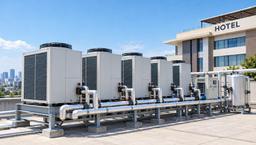
Heat Pump for Hotels: How to Reduce Hot Water Energy Costs Without Compromising Guest Comfort
10 September 2026
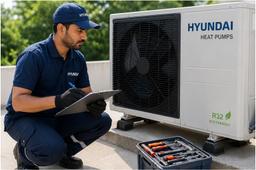
Heat Pump Maintenance Guide: How to Keep Your System Efficient and Reliable
02 September 2026
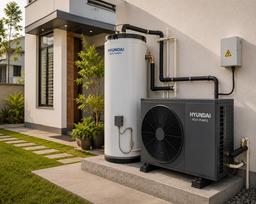
Heat Pump Water Heater for Home: How to Choose the Right System for Your Household
02 September 2026
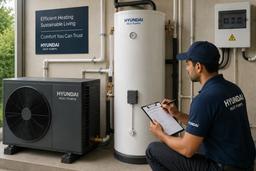
Heat Pump Water Heater Installation: Requirements, Process and Key Considerations
02 September 2026

Dehumidifier vs Air Conditioner: Which Is Right for You?
24 July 2026
No related articles found.